Mobile Soil Washing Equipment for Heavy Metal Contaminated Soil
Mobile soil washing equipment for heavy metal contaminated soil: fast deployment, modular design and proven cleanup results from Desen Environmental.
Mobile Soil Washing Equipment for Heavy Metal Contaminated Soil
Heavy metal contamination rarely waits for a convenient construction window. A former plating plant in the middle of a city, an old smelter lot with a hard deadline, a cluster of small parcels that each need their own fix. These are exactly the sites where a fixed treatment line feels like overkill. Mobile soil washing equipment was built for this reality: it arrives as a complete process train on wheels, hooks up to a flat hardstanding area, and starts producing clean material within days rather than months. Desen Environment, based in Zhengzhou, China, has been refining this approach through real remediation projects, and the results are worth looking at closely.
How Mobile Soil Washing Handles Metal Contamination
The principle behind the technology is straightforward: water and a carefully dosed washing reagent are used to loosen the bond between metal contaminants and soil particles. Once the metals are dissolved or detached, they follow the liquid phase, which makes them much easier to remove than trying to dig them out of solid soil.
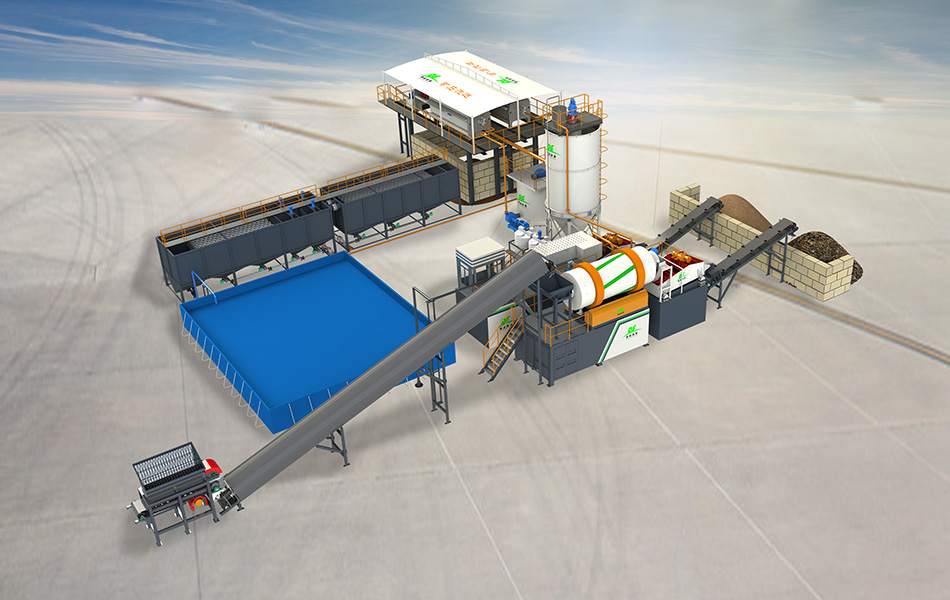
In practice, a mobile washing line runs through several linked stages. A scrubbing unit works the soil into a slurry, using high-energy friction to strip contamination off grain surfaces. A vibrating screen and classifier split the stream by particle size, so coarse aggregate and fine material can be treated separately. The fines then move into a thickening and filter press stage where solid and liquid are separated. Cleaned water is recycled back into the process, with a recovery rate above 90% on the mobile systems Desen supplies.
Why particle classification matters
Heavy metals tend to concentrate on the finest soil fractions. By splitting the material into size bands before final treatment, the mobile plant reduces the volume that needs intensive chemical handling. The result is less reagent consumption and a smaller volume of contaminated residue to manage, which has a direct effect on project cost.
What Makes a Mobile Platform Worth the Investment
The strongest argument for mobile soil washing equipment is deployment speed. The DS-MSW series from Desen is built onto standard trailer platforms, so the whole train can be moved by road, rail or sea freight. On site, setup typically takes one to three days. There is no concrete foundation to pour and no complex civil work. The system is fully enclosed, which keeps dust and noise inside the process and makes it workable in built-up urban areas.
- Rapid turnaround: projects can start within 24 hours of arrival in favourable conditions.
- Compact footprint: the integrated line occupies a fraction of the space of a fixed plant, around 1,200 m² including layout for a 10–15 t/h configuration.
- Multi-site reuse: the same train moves to the next parcel when one job finishes, spreading the capital cost over several projects.
- Modular flexibility: washing, classifying, filter pressing and water treatment run as separate trailer units that can be combined or scaled to match the site.
Operations are managed through a PLC-based control system with DCS architecture, and remote monitoring is available through cloud connectivity, so a small crew of two or three operators can run the line without a large on-site team.
Field Experience with Mobile Heavy Metal Remediation
The case record from Desen gives a practical picture. In Wenzhou, a mobile washing plant treated lead and arsenic contaminated soil at 15 tonnes per hour. In Beijing, a mobile washing unit handled arsenic pollution through ex-situ chemical washing, proving the approach in a northern climate. In South China, a skid-mounted system at 30 t/h treated mixed heavy metal contamination from industrial land. Across the database of more than a thousand soil remediation projects served by Desen, heavy metals including lead, arsenic, mercury, nickel and chromium account for the largest share of contaminants treated with mobile and modular equipment.
Equipment Configuration at a Glance
A typical mobile train supplied by Desen includes a scrubbing trailer with bar screening, a classification trailer with spiral classifiers and hydrocyclones, a filter press trailer for dewatering, and a water treatment trailer that keeps the loop closed. Each unit is self-powered with hydraulic levelling, and the electrical systems are independent per module. The configuration can be adjusted to suit the contaminants on a specific site, which is one reason the platform has been applied to oil and organic pollution as well as metals.
FAQ
Q: What cleanup levels can mobile soil washing reach?
Treated soil can meet EU, US EPA and Middle East environmental standards, with target values set according to the project specification and local regulation.
Q: How long does it take to deploy the equipment?
Field deployment usually takes one to three days. The equipment is delivered on trailers and requires only a level, hardened area plus standard utilities.
Q: What happens to the wash water and residue?
Wash water is treated on site and recycled, with a reuse rate above 90%. Solid residues are dewatered and managed according to their classification, either as clean fill or as waste for licensed disposal.
Q: Can the same system treat other contaminants?
Yes. The mobile line has been used for petroleum hydrocarbons and organic pollutants in addition to heavy metals, making it a flexible asset for contractors working across different sites.
For projects where time, site access and budget all pull in different directions, mobile soil washing equipment offers a path that keeps all three under control. Desen Environment (Zhengzhou Desen Environmental Technology Co., Ltd.) supplies, customises and supports the full mobile range, with engineering experience accumulated across China and the Middle East. More information, including technical specifications and case studies, is available at materialwashing.com.