Thermal Soil Washing Equipment for Oil-Contaminated Soil
Thermal soil washing equipment for oil-contaminated soil: process, modules and selection guidance backed by Desen field projects.
Thermal Soil Washing Equipment for Oil-Contaminated Soil
Oil spills do not stay neatly in one place. They soak into the ground, cling to aggregates, and leave behind a sticky layer that ordinary digging cannot remove. The equipment that deals with this problem has to be just as stubborn as the contamination itself. Thermal soil washing equipment combines high-energy scrubbing, chemical dosing and careful water management to pull petroleum hydrocarbons out of soil at scale. Desen Environment has been applying this technology in China and the Middle East for years, and the field data from those projects makes the selection process a lot easier to navigate.
How Thermal Washing Breaks the Oil-Soil Bond
The starting point is a simple observation: oil coats soil particles and binds fine grains into clumps. Before any chemistry can work, those clumps have to be broken apart. A rotary scrubbing drum does the job by lifting and tumbling the material, letting particles grind against each other so the oil film and soil aggregates separate. Water is added at roughly 2.5 parts per tonne of soil, together with a washing reagent that helps dissolve the hydrocarbons.
After scrubbing, the slurry passes a vibrating screen where particles larger than 2 mm are split off. The remaining fines enter an immersion module, where reagent and oil get time to react fully. Floating oil and scum are skimmed off in an oil separation tank and handled as waste, while the slurry moves to a secondary classification stage. Fine sand in the 0.15–2 mm range is recovered there, and the finest mud goes to a deep cone thickener with flocculant dosing. A filter press dewaters this sludge into a manageable cake, and the pressed water is treated with PAC, PAM and hydrogen peroxide before being returned to the washing circuit. Water reuse on the system regularly stays above 90%.
What a Complete Thermal Washing Line Includes
Desen builds its thermal soil washing equipment on a modular basis, which keeps both installation time and future adjustments under control. A typical washing line for oil-contaminated soil is made up of:
- Feed module: a hopper with bar screen and breaker to handle sticky, lumpy soil and meter it evenly into the process.
- Scrubbing and screening module: the rotary drum, primary screen and slurry pumps that create and sort the wash slurry.
- Immersion and classification module: heated soaking tanks with an integrated oil separation section, plus spiral classifiers and hydrocyclones for size banding.
- Deep cone thickening and filter press modules: flocculation and dewatering that turn the finest slurry into dry cake.
- Water treatment module: lamella settlers, reaction tanks and dosing systems that close the water loop.
- Electrical control module: DCS-based automation with local and remote monitoring, so the whole line is visible from a single control room.
Throughput is sized to the project: Desen supplies configurations from 15 up to 100 tonnes per hour, and the modules can be rearranged when the site conditions change.
Choosing the Right System: Selection Factors That Matter
Equipment selection usually comes down to four questions. First, what is the hydrocarbon load? Thermal soil washing equipment suits soil with petroleum hydrocarbon content below 50,000 mg/kg. Above that range, heavier bituminous or solidified oily sludge is better handled by other routes. Second, what is the soil texture? Sandy and loamy soils wash quickly, while clay-heavy material needs more scrubbing power and longer soaking. Third, how much throughput does the schedule demand? That single number drives the module count and the power budget. Fourth, is the site permanent or temporary? A fixed layout saves moving costs on a long-term project, while modular or mobile lines protect the investment when the contamination is spread across several parcels.
Operating costs deserve attention too. For a 30 t/h line, installed power is around 400 kW and typical consumption sits near 260 kWh per operating hour. A crew of three to four people per shift is enough, thanks to the automation. The payback logic becomes clearer when these figures are compared against the cost of hauling contaminated soil off site for disposal.
Evidence from the Field
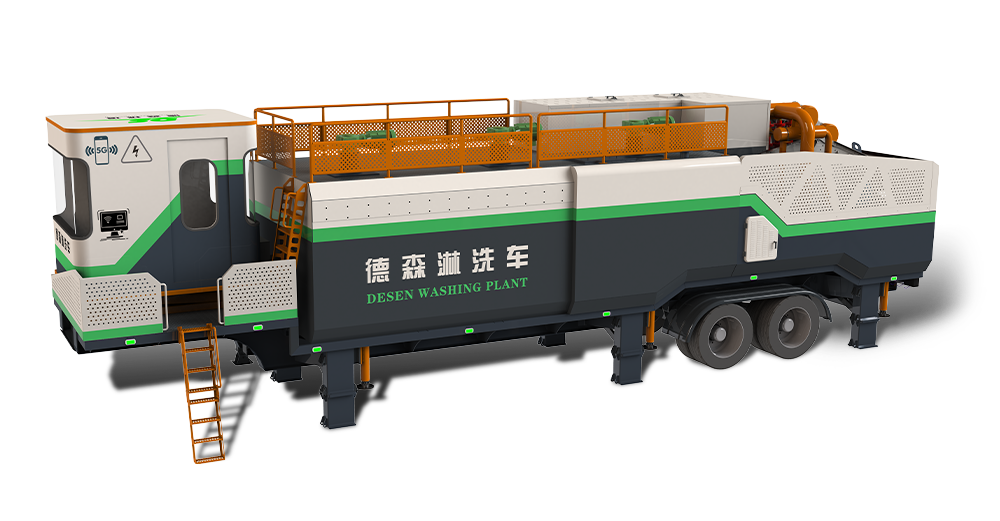
The reference list is concrete. In Ningxia, China, Desen equipment treated roughly 180,000 m³ of sandy soil contaminated with petroleum hydrocarbons, benzene and related compounds at 30 t/h, using washing followed by biopiles. In the Middle East, a 300,000 m³ oil-contaminated soil project ran at 25–30 t/h on soil averaging 5–8% oil content. In Abu Dhabi, a mobile washing unit delivered by Desen has processed around 100,000 tonnes of oil-contaminated soil, bringing residual oil content below 2,000 mg/kg and recovering approximately 5,000 tonnes of crude oil along the way. These are the kind of numbers that hold up in a project review.
FAQ
Q: What concentration of oil can thermal washing handle?
The process is designed for soil with total petroleum hydrocarbon content below 50,000 mg/kg. Higher concentrations, such as solidified heavy crude or bituminous sludge, usually require a different treatment approach.
Q: Is the wash water really recycled?
Yes. The water treatment module removes suspended solids and oxidises organic contaminants, and the cleaned water returns to the washing loop. Reuse rates above 90% are routine on Desen systems.
Q: What standards can the treated soil meet?
Target levels are set per project and can align with EU, US EPA or Middle East environmental requirements, depending on the local regulator and the reuse plan for the material.
Q: How long does installation take?
Because the line is modular and requires no concrete foundation, a typical 30 t/h system can be installed and commissioned within about 15 days of equipment arrival.
Thermal soil washing equipment is not a one-size-fits-all purchase, but with the right throughput, the right modules and an experienced partner, it turns an oil-stained liability into clean fill and recoverable oil. Desen Environment (Zhengzhou Desen Environmental Technology Co., Ltd.) designs, builds and supports washing systems from 15 to 100 t/h, with engineering references across Asia and the Middle East. Technical specifications and project details are available at materialwashing.com.