Petroleum Hydrocarbon Soil Remediation Workflow
A field-tested petroleum hydrocarbon soil remediation workflow: washing stages, water recycling, project results and FAQs from Desen Environment.
Petroleum Hydrocarbon Soil Remediation Workflow
Cleaning up an oil-contaminated site is rarely a single-machine problem. It is a logistics problem with chemistry attached: soil arrives in batches, contamination is uneven, and the contractor is judged on laboratory results, not on tonnage moved. A reliable petroleum hydrocarbon soil remediation workflow ties every stage together — stockpile management, batch testing, washing, dewatering and verification. This article lays out that workflow the way Desen Environment runs it in the field, with operating numbers from two large projects behind it.
Why Batch Workflow Beats One-Shot Processing
Petroleum hydrocarbon contamination is not uniform across a site. A fuel spill pools, migrates and weathers differently in each soil layer, so a single treatment pass either wastes capacity on clean pockets or leaves hot spots behind. In petroleum hydrocarbon soil remediation, treating the material in batches solves that: each stockpile is tested, blended and fed to the plant at a rate the equipment can handle, and the results are tracked against a cleanup target instead of an assumption. Batch workflow also makes the numbers honest in petroleum hydrocarbon soil remediation, because the contractor can report exactly what left each pile.
The Petroleum Hydrocarbon Soil Remediation Workflow Step by Step
Excavated soil is first moved to a covered pre-treatment area, where an ALLU bucket screens and breaks the material — the opening step of the petroleum hydrocarbon soil remediation workflow. Oversize blocks are removed, and the soil is transferred to the washing feed. From there, the petroleum hydrocarbon soil remediation workflow runs through three well-defined stages.
1. Scrubbing and primary screening
In the drum scrubber, soil is mixed with wash water at a 2.5:1 water-to-soil ratio, with a washing agent added. The drum's internal friction bars lift, tumble and drop the material, breaking oil films and soil agglomerates apart. The slurry then hits a hydraulic screen that removes everything coarser than 2 mm; those blocks are crushed later and sent to a biopile.
2. Soaking, oil recovery and classification
The minus-2 mm slurry enters a soaking module where the reagent has time to dissolve and react with the hydrocarbons. An oil trap at the back of this stage collects free oil as floating scum, which is hauled away as hazardous waste. The treated slurry moves to a second-stage classifier that recovers clean fine sand between 0.15 and 2 mm; that sand goes straight to a biopile for polishing.
3. Dewatering and water recycling
Fines below 0.15 mm are thickened in a deep-cone tank with PAM flocculant, then pressed in a plate-and-frame filter press. The filtrate and overflow water run through an integrated water treatment module, where PAC, PAM and hydrogen peroxide remove suspended solids and residual organics. Recovered water is recycled back to the scrubber, and the closed loop keeps water reuse above 90 percent.
Technical Advantages That Show Up in the Budget
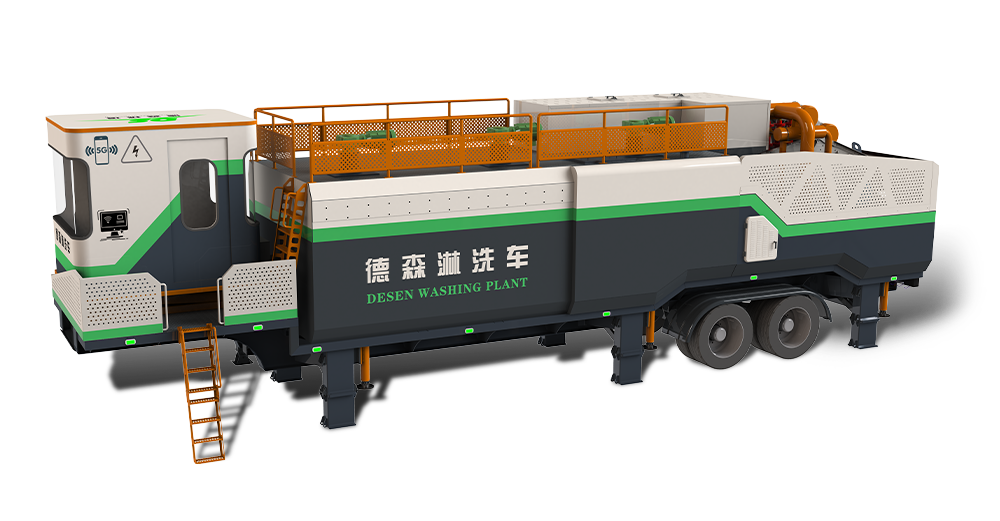
The equipment line behind this petroleum hydrocarbon soil remediation workflow — Desen Environment's DSLX series — is built to keep the numbers predictable. Capacities run from 15 to 100 tonnes per hour, and a 30 T/H line occupies roughly 1,200 m² without heavy foundations, which matters on rented land. Installation takes about 15 days, power draw stays under 400 kW (about 260 kWh per operating hour), and the crew is three to four people per shift. Because the line is modular, the contractor can add or remove modules as project tonnage changes.
Perhaps the biggest advantage in petroleum hydrocarbon soil remediation is volume reduction. Clean sand goes back to the site as backfill or construction material, while only the concentrated fines, scum and sludge leave as waste. Instead of hauling the entire contaminated mass, the project ships a small, well-characterised fraction to a licensed facility.
Field Practice: Ningxia and the Middle East
In Ningxia, Desen Environment treated roughly 180,000 m³ of sandy soil contaminated with petroleum hydrocarbons (C6-C9 and C10-C40), benzene, ethylbenzene, benzo(a)pyrene and chloroform at 30 tonnes per hour. The petroleum hydrocarbon soil remediation project combined soil washing with biopile treatment: the washing line removed the bulk of the petroleum hydrocarbons, and the recovered sand and sludge cakes finished in aerobic biopiles before final verification.
The same petroleum hydrocarbon soil remediation approach scaled up in the Middle East, where a 300,000 m³ oil-contaminated site ran at 25-30 tonnes per hour on soil averaging 5 to 8 percent petroleum hydrocarbons. There, washing was paired with bioremediation, and the mobile, modular configuration let the contractor redeploy equipment as treatment progressed across the site. Both projects are documented on materialwashing.com.
Frequently Asked Questions
What contamination levels can soil washing handle?
In petroleum hydrocarbon soil remediation, the DSLX line is designed for soils below 50,000 mg/kg total petroleum hydrocarbons. For heavier material, such as viscous heavy oil or asphalt-like sludges, thermal desorption or incineration is usually needed first.
How is the recovered oil disposed of?
Free oil collected in the oil trap and the scum from the water treatment stage are classified as hazardous waste and sent to licensed disposal facilities. The goal of the petroleum hydrocarbon soil remediation workflow is to concentrate contamination into this small stream rather than spread it through the project.
Does the process work on clay-rich soil?
Yes. The drum scrubber is designed to break oil-coated films and soil agglomerates, and the line adapts to sandy, loamy and silty-clay soils. Feed preparation, including the ALLU bucket and crushing steps, handles sticky material before it reaches the washer.
What standards can treated soil meet?
Treated soil can be matched to EU, US EPA or Middle East cleanup criteria depending on the client's regulatory requirement. Desen Environment's engineers size the petroleum hydrocarbon soil remediation workflow against the target values before equipment is shipped.
Closing Thought
Petroleum hydrocarbon soil remediation is a repeatable process once the workflow is right. Zhengzhou Desen Environmental Technology Co., Ltd. has delivered washing lines from 15 to 100 T/H across China and the Middle East, and the same engineering team that designs the equipment also plans the batch workflow around it. Send a soil analysis to Desen Environment and you will get a petroleum hydrocarbon soil remediation workflow matched to your tonnage, contaminant profile and cleanup deadline.
上一篇:Mobile Screening Plant for C&D Waste Recycling
下一篇:没有了!