Modular Soil Washing Plant Systems for Industrial Site Remediation
Desen's modular soil washing plant systems range from 15–100 t/h for industrial site remediation. DCS-controlled, water-recycling design suitable for heavy metal, TPH, and composite contamination projects.
Industrial site remediation projects demand equipment that balances processing capacity, operational flexibility, and cost efficiency. Modular soil washing plant systems meet these requirements by combining standardized process units that can be configured for diverse contamination profiles and project scales. Desen Environmental's DSLX series represents a mature deployment of this modular approach, with over 2 million cubic meters of soil treated across projects in China and the Middle East.
Modular Architecture for Flexible Deployment
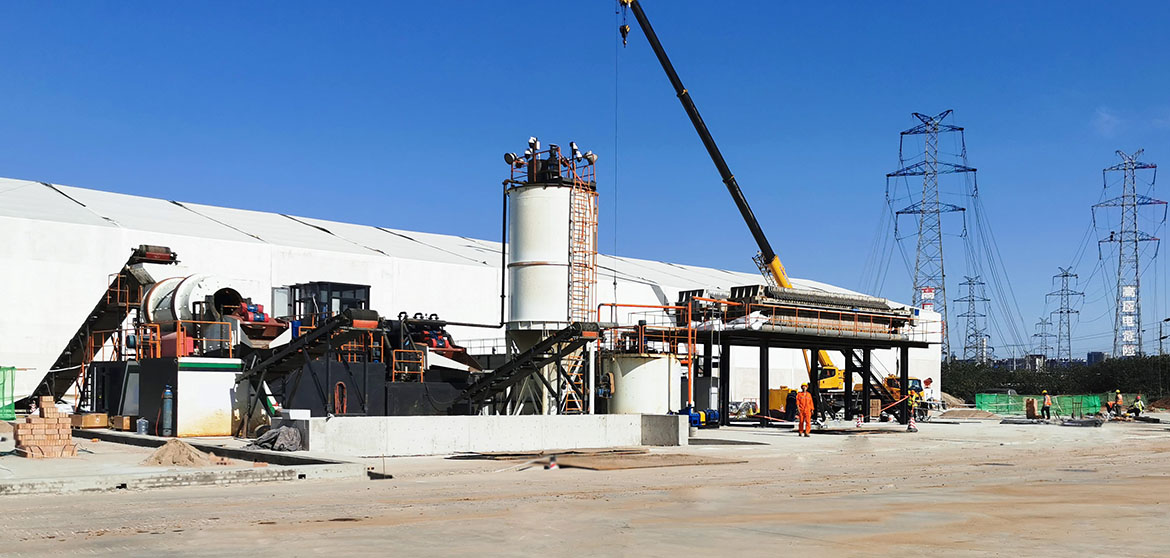
The DSLX modular soil washing system comprises seven standardized process modules that connect on site without requiring permanent foundations or extensive civil works. This modular approach delivers several operational advantages:
- Configurable capacity: Standard production lines from 15 to 100 tons per hour, achieved by scaling individual module sizes rather than redesigning the entire system
- Reduced installation time: Typical commissioning within 15 days of equipment arrival, compared to months for conventional fixed installations
- Relocatable assets: Modules can be disassembled, transported, and redeployed to new project sites, extending equipment service life beyond a single contract
- Phased investment: Operators can start with core modules and add capacity as project scope expands
A 30 t/h production line occupies approximately 1,200 square meters (30 m × 40 m), with total installed power under 400 kW and actual operating consumption around 260 kWh. Each shift requires 3–4 operators, excluding excavator and loader personnel for material handling.
Process Flow and Technical Features
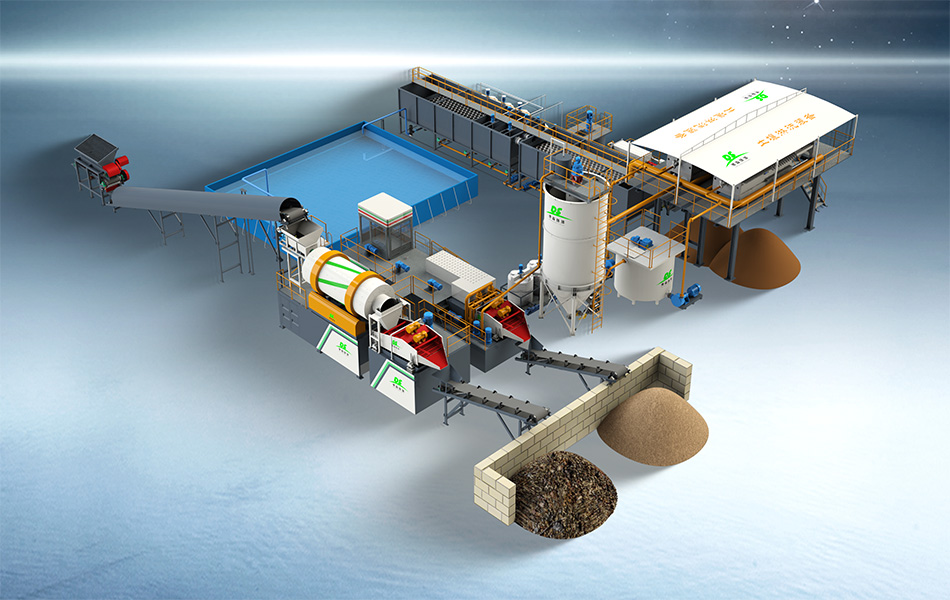
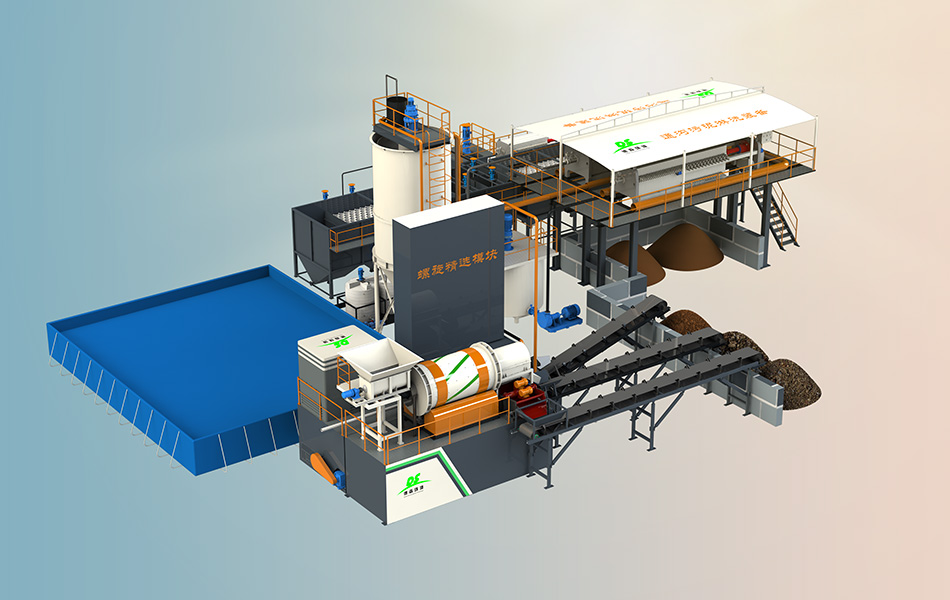
The complete process train integrates seven functional stages:
1. Feeding and pre-treatment: A bunker feeder with variable-frequency drive ensures uniform material delivery. An integrated crushing mechanism breaks down agglomerated soil clods for consistent processing.
2. Rotary drum scrubbing: Contaminated soil enters a rotary scrubber where high-intensity friction, lifting, and tumbling actions dislodge contaminants from particle surfaces. This stage operates at a water-to-soil ratio adjustable from 1:1 to 5:1 depending on soil characteristics.
3. Coarse screening: A linear-motion vibrating screen separates particles larger than 2 mm as clean coarse aggregate, which is discharged via belt conveyor.
4. Fine classification and chemical leaching: Slurry passing the 2 mm screen enters the soaking and classification module, where chemical reagents react with contaminants in a temperature-controlled environment. A spiral classifier combined with hydrocyclones achieves precise separation at the 0.15 mm boundary.
5. Deep-cone thickening: Fine-particle slurry concentrates in a deep-cone thickener where flocculant addition accelerates settling. Overflow water returns to the treatment circuit.
6. Filter press dewatering: Thickened sludge is pumped to a plate-and-frame filter press for mechanical dewatering, producing a solid filter cake for disposal or further treatment.
7. Water treatment and recycling: Process water passes through inclined-plate sedimentation, chemical reaction tanks, and secondary clarification before recycling. The system achieves ≥90% water reuse.
All modules operate under DCS intelligent control with 5G cloud connectivity, enabling real-time remote monitoring and data logging for regulatory compliance.
Contamination Types and Project Applications
The DSLX system handles multiple contaminant categories. For heavy metal contamination (chromium, lead, cadmium, nickel, zinc) at smelter sites, electroplating facilities, and mining areas, the system uses chemical leaching with pH-adjusted reagents. For petroleum hydrocarbon contamination, thermal washing with surfactant dosing and oil-water separation is applied. Composite contamination sites—where TPH and heavy metals co-exist—benefit from combined reagent programs within the same process train.
Notable project deployments include the Changsha Chromate Plant remediation (the largest single-site remediation project in China), the Hangzhou Steel heritage park project, and multiple oilfield remediation programs in the UAE. The modular washing system has also been adopted for slurry treatment applications including tunnel boring mud, dredged sediment, and pipeline maintenance waste.
For site-specific feasibility analysis, our technical team provides sample testing and process validation. Visit our mobile screening plant page to learn about pre-treatment equipment that integrates with modular washing lines.