TPH Contaminated Soil Washing: How Desen Environment Remediates Petroleum Hydrocarbon Sites with Mobile and Modular Washing Plants
TPH Contaminated Soil Washing: How Desen Environment Remediates Petroleum Hydrocarbon Sites with Mobile and Modular Washing PlantsDiesel spills, crude leaks, tank farms that operated for decades — petroleum contamination turns up in more places than most developers expect. Left alone, it mig
TPH Contaminated Soil Washing: How Desen Environment Remediates Petroleum Hydrocarbon Sites with Mobile and Modular Washing Plants

Diesel spills, crude leaks, tank farms that operated for decades — petroleum contamination turns up in more places than most developers expect. Left alone, it migrates, smells, and keeps failing screening values year after year. TPH contaminated soil is rarely one problem either. Gasoline fractions evaporate quickly. Diesel-range compounds cling to silt. Heavy residues coat clay particles like grease on a pan. Soil washing handles all of these fractions inside a single treatment train, which is why contractors keep coming back to it.
What Makes TPH Contaminated Soil Hard to Treat
TPH stands for total petroleum hydrocarbons. It is an umbrella term for the carbon chains — roughly C6 to C40 — that leave a refinery as fuels, lubricants, and crudes. Each chain behaves differently in soil. That behaviour, more than the total concentration, decides which remedy will work.
Weathered spills are the worst cases. Light ends evaporate or degrade, leaving a sticky residue that has soaked deep into the matrix. On TPH contaminated soil from old tank farms, that residue can sit undisturbed for decades. The oil does not spread evenly either. Silt and clay typically make up only 10–30% of the soil volume, yet they hold most of the contaminant mass, because hydrocarbons bind tightly to fine particles. Treating the whole volume with heat or biological means is slow and expensive when most of the mass sits in a fraction you could simply separate.
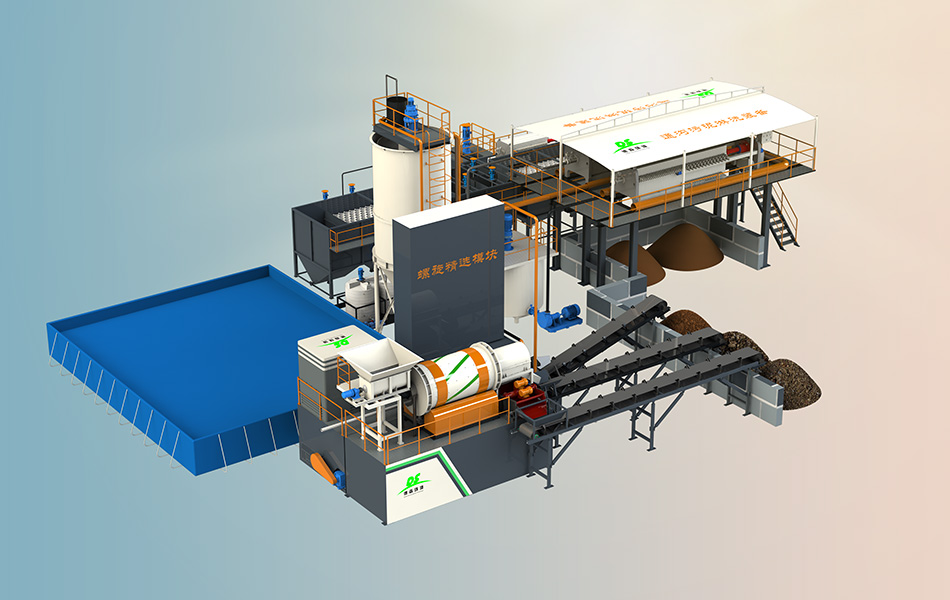
Washing inverts the logic. Instead of destroying every molecule in place, a washing plant splits the soil into streams and concentrates the oil into the smallest possible volume. Three mechanisms do the work:
- Attrition scrubbing, which grinds coated grains against each other to release oil films from sand surfaces.
- Surfactant-enhanced washing, which lifts weathered oil off fines so it can be carried away in the wash water.
- Mechanical separation — screening, hydrocycloning, flotation, and dewatering — which splits clean sand from contaminated fines and emulsion.
The clean sand goes back to the excavation. The contaminated concentrate, now a small fraction of the original tonnage, moves to treatment or disposal. That is the whole point of the method.
Project Numbers: What Washing Delivers on Real Sites
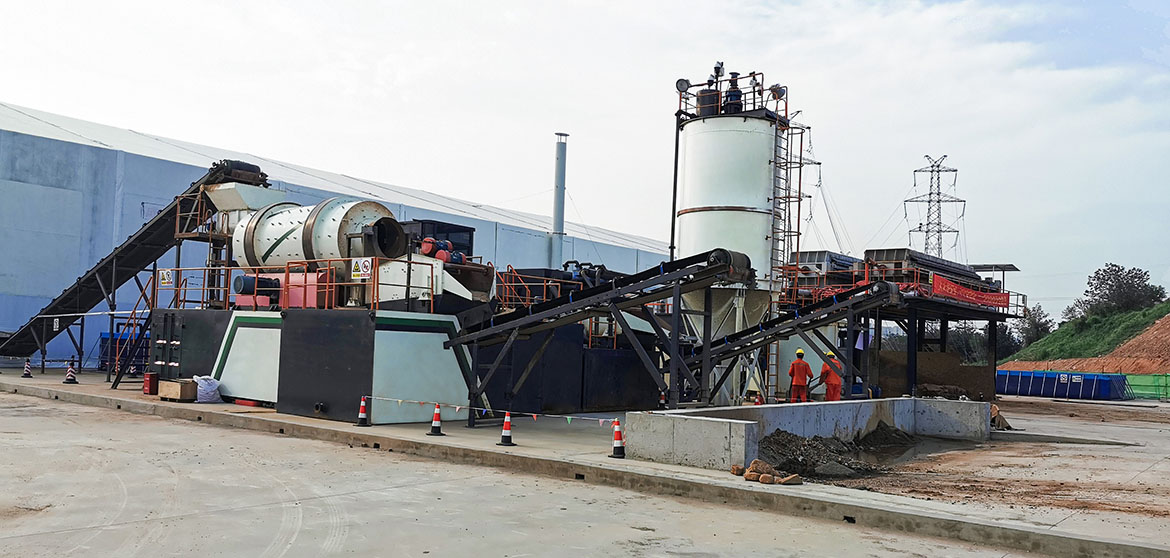
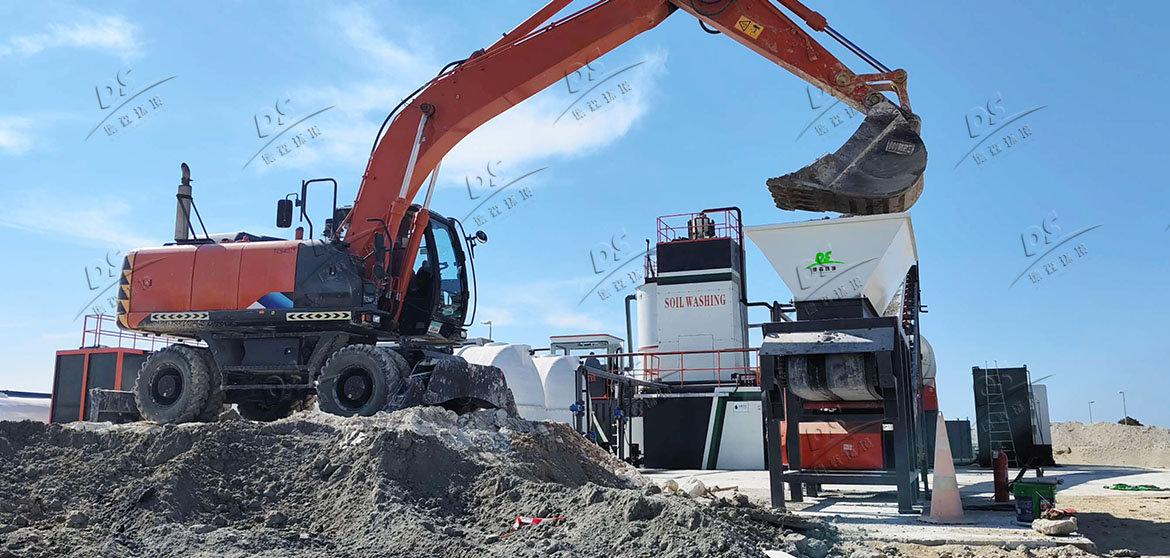
Field data from Desen Environment installations shows why owners choose this route. In Wenzhou, Desen set up a mobile washing unit on an old industrial plot and ran the campaign in stages, shifting the skids as excavation moved across the site. The feed there was typical of TPH contaminated soil on former industrial land: oily sand, patches of clay, and buried debris that had to come out before washing. The plant screened at 50 mm, scrubbed the undersize in an attrition scrubber, and pushed all wash water through a closed treatment loop.
A 40 t/h mobile line like that one moves about 3,200 tonnes per week on double shifts — roughly 2,000 cubic metres of excavated soil. Over the full Wenzhou campaign and similar deployments in Chongqing and Guangdong, the sand fraction, normally 80–90% of the feed, came back clean enough to reuse as backfill. Verification samples went to a third-party laboratory before any material returned to the ground. Wash water recycled at above 90%, with top-up needed only for evaporation and the moisture trapped in filter cake.
Those numbers matter at tender stage. A contractor can size the plant, quote the weekly tonnage, and show the regulator exactly where every cubic metre goes. No black boxes, no promises that cannot be sampled.
Equipment Selection: Mobile Washing Unit or Fixed Plant?
Desen Environment builds both configurations, and the choice usually comes down to volume and schedule rather than technology. A fixed plant earns its keep on long-term campaigns where soil keeps arriving for years. A mobile washing unit suits sites measured in months, or projects where the contamination sits in scattered source areas.
For TPH work, the mobile route has practical advantages beyond cost. TPH contaminated soil usually sits in tight, irregular pockets around tanks and pipelines, so a plant that can chase the plume beats one bolted to a concrete pad. Refinery turnarounds and demolition windows do not wait for concrete foundations. A containerised or skid-mounted line mobilises in weeks, starts producing, and relocates when a hotspot is done. The units tolerate cold weather operation and leave no permanent footprint, which simplifies permitting on leased land.
Whichever configuration fits, look for these features in the train:
- A scrubbing stage strong enough for weathered residues, not just fresh spills.
- Surfactant dosing and flotation that can be tuned during the treatability trial.
- Closed-loop water treatment sized for the fines load, not the clean-water ideal.
- PLC control with flow and pressure logging, so every shift produces auditable records.
Where TPH Soil Washing Fits Best
Refineries, tank farms, product depots, service stations, pipeline corridors, rail yards, and airports all generate the kind of contamination washing handles well. TPH contaminated soil from these sites rarely comes with a uniform recipe, which is exactly why a flexible washing train earns its keep. So do drilling mud pits and old industrial parks being redeveloped for housing. Washing suits sites where hydrocarbons sit in sandy or loamy material; heavy clay above roughly 35–40% needs pre-treatment or a different remedy, and a lab test will confirm that before money is spent.
The method also pairs neatly with other technologies. After washing, a short biopile or chemical oxidation step can polish residual concentrations on the fine fraction. When polycyclic aromatic hydrocarbons ride along with the TPH, the same train removes both. Desen has applied this thinking on metal-contaminated sites in Nanjing and on oil-impacted projects alike, and the equipment packages overlap far more than buyers expect.
Frequently Asked Questions
How clean can washed sand get?
On sandy material, washing routinely brings TPH contaminated soil back below local screening values for the reusable fraction. The fines stream, where most of the oil concentrates, needs separate handling. Site-specific results depend on clay content and how weathered the spill is.
Does washing work on old, weathered spills?
Yes, that is where the surfactant and attrition stages earn their keep. Aged oil is harder to remove than fresh product, which is why Desen always runs a treatability test first and tunes the chemistry to the actual soil.
How much water does the process use?
Far less than people assume. Water recirculates in a closed loop, with more than 90% reused. The plant only loses water to evaporation and to the moisture locked in dewatered filter cake.
Mobile or fixed washing plant — which should I pick?
Judge by tonnage and timeline. Short campaigns, remote sites, and multiple source areas favour a mobile washing unit. Multi-year projects with a steady soil supply favour a fixed plant. Desen Environment provides both and will size either against your excavation schedule.
How fast can a project actually start?
After sampling and a 4–8 week treatability programme, a mobile line can be producing on site within weeks of mobilisation. Fixed plants take longer because of civils, but they win on cost per tonne over the long run.
Start With a Treatability Test, Not a Guess
No two petroleum sites wash the same. Grain size, clay content, contaminant age, and the local screening values all change the recipe, and TPH contaminated soil dug from a refinery yard behaves differently from the same soil dug near a fuel terminal. A small jar test and a pilot run answer the questions that matter — removal efficiency, reagent dose, water balance, and disposal volumes — before you commit to a full campaign.
Desen Environment (Zhengzhou Desen Environmental Technology, 郑州德森环境) designs, builds, and commissions soil washing systems from a single skid to a full modular plant, and supports projects worldwide from its base in Zhengzhou, China. Send your site data to the team at materialwashing.com and get a process flow, a budget, and a timeline based on your soil, not on a brochure.